Relying on a single outreach channel is like fishing with one line in an ocean full of opportunities.
This is where LinkedIn multichannel prospecting has emerged as the most effective strategy for modern sales teams.
It combines the professional networking power of LinkedIn with email, cold calling, and other touchpoints.
This creates a comprehensive approach that maximizes lead generation and appointment booking conversion rates.
The statistics speak for themselves: B2B companies using multichannel prospecting strategies see 287% higher conversion rate compared to single-channel approaches.
When LinkedIn is at the center of your multichannel strategy, you’re not just reaching prospects. You’re building relationships. You’re establishing credibility. You’re creating multiple pathways to meaningful conversations.
This comprehensive guide will walk you through everything you need to know about LinkedIn multichannel prospecting.
It covers building your foundational strategy and implementing proven workflows. These workflows drive results.
Whether you’re a sales development representative looking to improve your outreach game or a founder, this guide helps you succeed.
Building Your Foundational GTM Strategy
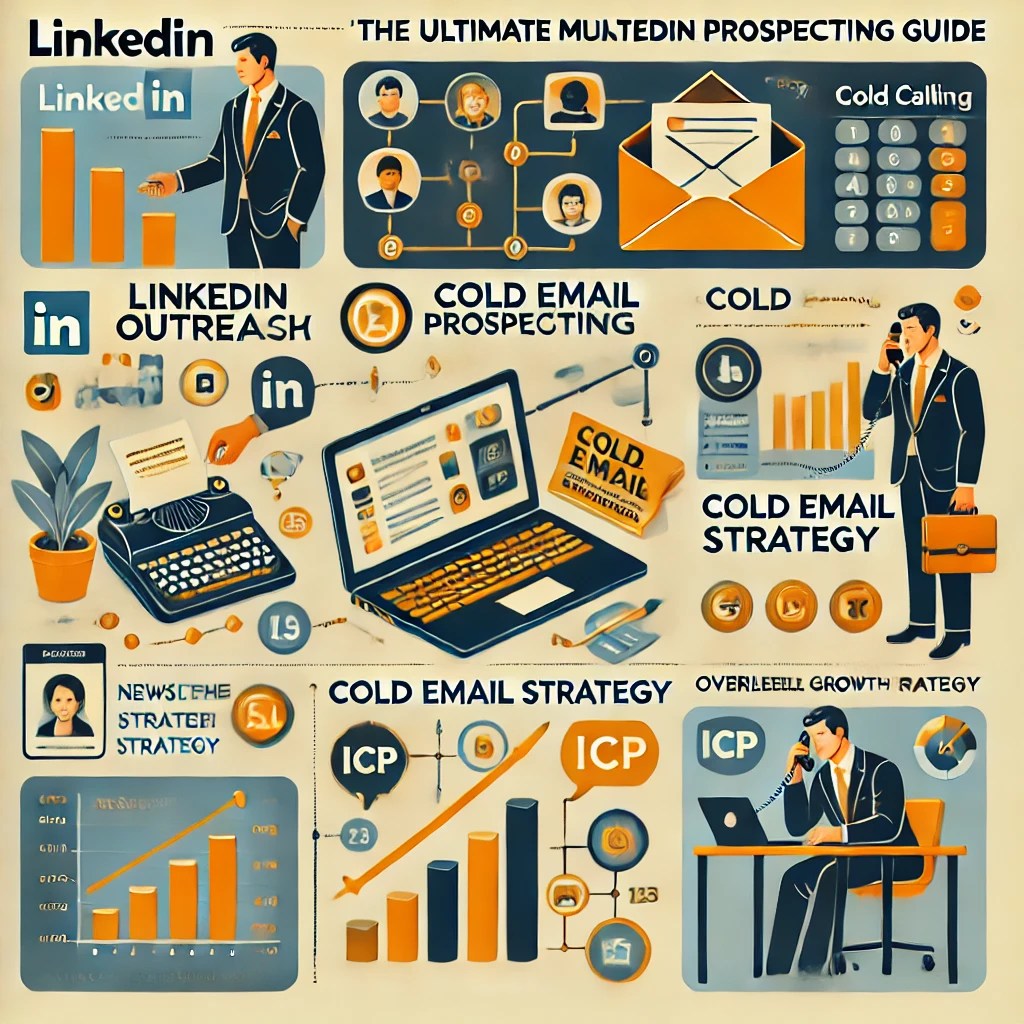
Defining Your Ideal Customer Profile (ICP)
The foundation of any successful LinkedIn multichannel prospecting campaign begins with crystal-clear identification of your Ideal Customer Profile.
Your ICP isn’t just a demographic description. It’s a detailed blueprint of the companies and individuals who are most likely to become your best customers.
When building your ICP for LinkedIn multichannel prospecting, consider these key dimensions:
Company-Level Characteristics:
- Industry and sub-industry classifications
- Company size (employee count and revenue)
- Geographic location and market presence
- Technology stack and tools currently used
- Growth stage and funding status
- Business model and revenue streams
Individual-Level Characteristics:
- Job titles and seniority levels
- Department and functional responsibilities
- Decision-making authority and influence
- Professional background and experience
- Pain points and challenges they face
- Goals and objectives they’re measured on
The key to effective LinkedIn multichannel prospecting is understanding not just who your prospects are. You also need to know where they spend their time online.
It’s important to understand how they prefer to communicate and what motivates them to take action.
This deep understanding will inform every aspect of your multichannel strategy, from your LinkedIn content approach to your email subject lines and cold calling scripts.
Crafting Compelling Messaging
Your messaging strategy is the bridge between your understanding of your ICP and your ability to engage them effectively across multiple channels.
In LinkedIn multichannel prospecting, your messaging must be consistent yet channel-appropriate, maintaining a cohesive narrative while adapting to the unique characteristics of each platform.
The Three Pillars of Multichannel Messaging:
- Value-First Approach: Every message should lead with insight, assistance, or value rather than a sales pitch. This is particularly crucial on LinkedIn, where professional relationships are built on mutual value exchange.
- Channel-Specific Adaptation: While your core message remains consistent, the delivery should match the channel. LinkedIn messages tend to be more conversational and relationship-focused, while emails can be more structured and information-dense.
- Sequence Coherence: Your messages across channels should build upon each other, creating a logical progression that guides prospects toward engagement without feeling repetitive or overwhelming.
Developing Your Message Framework:
Understand your prospect’s current state clearly. Find their desired future state. Recognize the obstacles preventing them from achieving their goals.
Your messaging should position your solution as the bridge between where they are and where they want to be.
Create message templates for each channel that address the same core pain points but leverage the unique strengths of each platform.
For LinkedIn, focus on industry insights and professional development. For email, provide detailed case studies and ROI calculations. For phone calls, emphasize immediate problem-solving and personalized consultation.
Bonus: Build Your Ideal Customer Signals Strategy
Here’s a comprehensive prompt to find your company’s specific Ideal Customer Signals. Follow this to implement the foundational GTM strategy outlined in this guide.
This strategic exercise will transform your LinkedIn multichannel prospecting from generic outreach to precision targeting.
Prompt: Find Your Ideal Customer Signals
Copy the entire prompt below and change it with your company name:
Start of prompt

You are a Go-To-Market strategist tasked with helping a SaaS company uncover its Ideal Customer Signals (ICS)—observable changes in a prospect's environment that indicate buying intent, a business objective, or pain that the company's products can solve.
Use a Chain of Thought approach to reason step-by-step through the problem. For each section, think critically, ground insights in company context, and connect signals to clear GTM actions.
Step 1: Understand the Company
Research the company {Company Name} and summarize:

What does the company sell? (product lines, core capabilities)
What business pains or objectives does it address?
Who are the primary personas involved (users, champions, buyers)?
What is the Ideal Customer Profile (ICP)? (industry, size, maturity, hiring, tech stack)
What is the go-to-market motion? (Product-led, sales-led, hybrid)
How are leads typically acquired and converted? (e.g., trial, demo, outbound, ABM)

Step 2: Identify Triggers of Need
List the types of internal objectives, transitions, or pain points that signal the need for this company's offering.
Phrase each as:
"If [situation or goal] is happening at a company, then they likely need [product or value]."
Step 3: Identify External Signals (ICS)
Now reverse-engineer: What external signals suggest the above triggers are happening?
Organize the ICS into the following categories:

Demographic & Firmographic (e.g., size, funding, industry shift)
Hiring & Org Design (e.g., security team expansion, new roles)
Technographic (e.g., container usage, tech migrations, tool adoption)
People Movement (e.g., new CISO hire, dev lead joins from customer org)
Initiatives & Programs (e.g., DevSecOps, compliance projects)
Public Announcements & Strategy (e.g., product launches, partnerships)
Web & Content Signals (e.g., reading blog posts, attending webinars)
Intent & Behavioral (e.g., G2 visits, trials, marketing engagement)

Step 4: For Each Signal, Provide the Following:

Signal: (e.g. "Hiring Director of Cloud Security")
What it Indicates: (What's the likely objective or pain?)
Why Now: (Why is this a good moment to engage?)
Primary Persona(s): (Who is most likely to act on this?)
Buying Stage: Awareness / Consideration / Decision
Messaging Angle: (Hook that speaks to this moment/persona)
Campaign Ideas: (Outbound play, ad targeting, webinar theme, etc.)
Best Channels: (e.g., LinkedIn, G2, SalesLoft, paid search)
Ease of Detection: (Low / Medium / High — based on how reliably and at scale this can be tracked)
How to Programmatically Detect: (Describe the data source and detection logic. Examples:

Parse job boards for "DevSecOps" roles
Use technographic databases to detect Kubernetes adoption
Track company-wide G2 traffic intent on AppSec tools
Monitor funding events via Crunchbase API)


Step 5: Define High-Intent Signal Clusters
Identify 3–5 signal clusters—combinations of ICS that strongly suggest buying intent. For each, provide:

Cluster Name
Signals involved
Interpretation (why this cluster matters)
Recommended play (how marketing/sales should act on it)

Step 6: Prioritize Top 10 ICS
Rank the top 10 most actionable signals by:

Likelihood of conversion
Strategic value (ICP fit)
Ease of detection
Present this in a scorecard format with prioritization rationale.

Step 7: Identify Cross-Sell & Competitor Displacement Signals

What ICS suggest the account is ready to expand product usage?
What ICS suggest dissatisfaction with a competitor?
Include messaging and campaign recommendations for each.

Let's begin with this company: {Company Name}
End of prompt
This comprehensive framework will help you build a data-driven foundation for your LinkedIn multichannel prospecting efforts.
By identifying and tracking these signals, you will be capable of engaging prospects at the perfect moment. You will reach them with the right message across the right channels.
Special thanks to Alex Lindahl for developing this strategic framework. For more insights on go-to-market strategy and data-driven prospecting, check out his newsletter at Claymation
Essential Tech Stack for LinkedIn Multichannel Prospecting
Getsales.io: Your LinkedIn Automation Engine
Getsales.io has become an indispensable tool for scaling LinkedIn multichannel prospecting efforts. It maintains the personal touch that makes LinkedIn relationships so valuable.
This platform excels at automating routine LinkedIn tasks while preserving the authentic, human element that’s crucial for professional networking.
Key Features for Multichannel Prospecting:
- Advanced LinkedIn connection automation with personalized messaging
- Profile visit tracking and engagement monitoring
- Automated follow-up sequences that can integrate with other channels
- CRM integration for seamless lead management
- Analytics and reporting for campaign improvement
The power of Getsales.io in a multichannel strategy lies in its ability to start relationships on LinkedIn. It seamlessly transitions prospects to other channels.
You can set up automated LinkedIn outreach sequences. Upon receiving positive responses, they can trigger email sequences or add prospects to calling lists.
Best Practices for Implementation:
- Start with conservative automation limits to avoid LinkedIn restrictions
- Personalize connection requests using prospect research and mutual connections
- Create multiple message sequences for different prospect segments
- Use the platform’s analytics to find the highest-performing message templates
- Regularly audit and update your automation rules based on performance data
I also created this post on LinkedIn. In it, I break down the step-by-step process of creating your first outreach campaign on Getsales.
Clay: The Data Enrichment Powerhouse
Clay revolutionizes the data foundation of your LinkedIn multichannel prospecting by providing comprehensive prospect research and data enrichment capabilities.
This platform transforms basic LinkedIn profiles into rich, actionable prospect intelligence that fuels personalized outreach across all channels.
Core Capabilities for Multichannel Success:
- Real-time data enrichment from multiple data sources
- Advanced prospect scoring and prioritization
- Automated research workflows that gather key talking points
- Integration with major CRM and sales engagement platforms
- Custom data fields and tags for precise targeting
Clay’s strength in LinkedIn multichannel prospecting comes from its ability to gather and synthesize information.
It collects data from LinkedIn profiles, company websites, news articles, and other public sources. This helps create comprehensive prospect profiles.
This enriched data enables highly personalized outreach that demonstrates genuine interest and understanding of each prospect’s unique situation.
Strategic Implementation:
- Research and Build Leads List as per your ICP directly from Clay
- Create custom scoring models based on your ICP criteria
- Use Clay’s research capabilities to identify conversation starters and pain points
- Integrate enriched data with Getsales
The 10 LinkedIn Outbound Rules

Rule 1: Open Conversations, Not Pitches
The cardinal rule of LinkedIn multichannel prospecting is to prioritize relationship building over immediate sales. Your initial outreach should focus on starting genuine conversations rather than delivering polished sales pitches. This approach builds trust and credibility, creating a foundation for long-term business relationships.
Rule 2: Research Before You Reach
Never send a generic message. Invest time in understanding your prospect’s background, recent activities, and current challenges. This research should inform not just your initial LinkedIn message but your entire multichannel approach.
Rule 3: Provide Value in Every Interaction
Each touchpoint should provide value to your prospect. This could be an industry insight, a relevant article, or a solution to a problem they’ve mentioned. This value-first approach differentiates you from competitors who lead with product features.
Rule 4: Maintain Professional Consistency
Your tone, messaging, and personal brand should remain consistent across all channels while adapting to each platform’s unique characteristics. Your LinkedIn presence should complement your email signature and phone conversation style.
Rule 5: Respect Response Preferences
Pay attention to where prospects engage with you and adapt your follow-up accordingly. If they respond to your LinkedIn message, continue the conversation there before transitioning to other channels.
Rule 6: Time Your Outreach Strategically
Use LinkedIn insights and activity data to time your outreach when prospects are most likely to be active and engaged. This timing strategy should coordinate with your email and calling schedules.
Rule 7: Leverage Social Proof
Share client success stories, case studies, and testimonials across your multichannel approach. LinkedIn is particularly effective for sharing social proof through posts and articles that your prospects can see.
Rule 8: Follow Up Persistently but Respectfully
Create a systematic follow-up process that spans multiple channels without being pushy. Your LinkedIn follow-ups should complement your email and phone follow-ups, creating multiple opportunities for engagement.
Rule 9: Track and Measure Everything
Monitor your LinkedIn multichannel prospecting performance across all touchpoints. Track connection rates, response rates, and conversion metrics to identify what’s working and what needs improvement.
Rule 10: Build Long-Term Relationships
Focus on building relationships that extend beyond immediate sales opportunities. The professionals you connect with today may become clients, partners, or referral sources in the future.
Three Pre-Built Multichannel Workflows for B2B Businesses

Workflow 1: LinkedIn + Cold Email
This foundational workflow combines LinkedIn’s relationship-building power with email’s detailed communication capabilities. It’s ideal for reaching decision-makers who are active on LinkedIn but may prefer email for detailed discussions.
Week 1-2: LinkedIn Warmup
- Day 1: Send personalized connection request with industry-specific talking point
- Day 3: Follow up with valuable content share (article, study, or insight)
- Day 7: Engage with prospect’s recent posts or company updates
- Day 10: Send LinkedIn message referencing mutual connection or shared interest
Week 3-4: Outreach Flow
- Day 15: Send email referencing LinkedIn connection with case study relevant to their industry
- Day 18: Follow up with additional resources mentioned in LinkedIn conversation
- Day 22: Send email with specific meeting request and agenda
- Day 25: Final LinkedIn message with meeting scheduling link
Success Metrics:
- LinkedIn connection acceptance rate: 30-40%
- Email open rate: 25-35%
- Email response rate: 8-12%
- Meeting booking rate: 3-5%
Workflow 2: LinkedIn + Cold Email + Cold Call
This comprehensive workflow adds phone outreach to create maximum touchpoints coverage. It’s particularly effective for high-value prospects who require multiple touch points before engaging.
Week 1: LinkedIn Initiation
- Day 1: Personalized connection ask
- Day 3: LinkedIn message with industry insight
- Day 5: Engage with prospect’s content
Week 2: Email Entry
- Day 8: Email introduction with LinkedIn connection reference
- Day 10: Follow-up email with case study
- Day 12: LinkedIn message acknowledging email outreach
Week 3: Phone Integration
- Day 15: Cold call referencing LinkedIn connection and email correspondence
- Day 17: LinkedIn message about phone call attempt
- Day 19: Email follow-up to phone call
- Day 21: Second phone call attempt
Week 4: Coordinated Follow-Up
- Day 22: LinkedIn message with meeting request
- Day 24: Email with specific meeting agenda
- Day 26: Final phone call with clear next steps
Success Metrics:
- Overall engagement rate: 45-55%
- Phone conversation rate: 15-20%
- Meeting booking rate: 6-8%
- Pipeline conversion rate: 12-15%
Workflow 3: Cold Call + Cold Email + LinkedIn + Newsletters
This advanced workflow starts with phone outreach to create immediate engagement, then uses other channels to nurture and convert prospects. It’s ideal for urgent sales cycles and high-priority accounts.
Week 1: Phone-First Approach
- Day 1: Cold call with industry-specific opener
- Day 2: LinkedIn connection request referencing phone call
- Day 3: Email follow-up with promised resources
Week 2: Multichannel Nurturing
- Day 5: LinkedIn message with additional insights
- Day 7: Newsletter subscription offer via email
- Day 9: Second phone call with specific value proposition
Week 3: Content-Driven Engagement
- Day 12: LinkedIn article share with personal note
- Day 14: Email with exclusive industry report
- Day 16: Newsletter featuring prospect’s company (with permission)
Week 4: Conversion Focus
- Day 19: Phone call with meeting request
- Day 21: LinkedIn message with meeting agenda
- Day 23: Email confirmation with calendar link
- Day 25: Newsletter featuring meeting preparation resources
Success Metrics:
- Phone connection rate: 20-25%
- LinkedIn engagement rate: 35-40%
- Newsletter subscription rate: 10-15%
- Meeting booking rate: 8-12%
- Pipeline conversion rate: 18-22%
Implementing Your LinkedIn Multichannel Strategy
Success in LinkedIn multichannel prospecting requires careful planning, consistent execution, and continuous optimization. Start by selecting the workflow that best aligns with your target market and sales process. Test your approach with a small group of prospects before scaling to larger volumes.
Remember that LinkedIn multichannel prospecting is not about volume. It’s about creating meaningful connections. These connections lead to valuable business relationships.
Focus on quality over quantity, and always prioritize the prospect’s experience over your own convenience.
The future of B2B sales belongs to those who can master the art of multichannel prospecting. They must also maintain the human touch that builds lasting business relationships.
Follow this guide carefully. Continuously refine your approach based on results. You’ll build a LinkedIn multichannel prospecting system that drives consistent pipeline growth. This leads to business success.
Your prospects are waiting for someone who understands their challenges. They need someone who provides genuine value and approaches them as a trusted advisor. They do not want just another salesperson.
With the right strategy, tools, and execution, LinkedIn multichannel prospecting can become your most powerful business development engine.
Ready to Scale Your LinkedIn Multichannel Prospecting?
If you’ve made it this far, you’re serious about transforming your prospecting results. This guide provides the strategic foundation.
However, generating predictable results consistently requires the right processes. It also needs the right templates and automation.
Get The Exact 7 Steps LinkedIn Multichannel AI System that we use to Book 20-30 Appointments Per Month!
What You’ll Get:
✅ Our Complete multichannel workflow templates – Ready-to-use sequences for LinkedIn, email, and phone outreach
✅ AI-powered Personalisation prompts – Proven prompts that create compelling, personalized messages at scale
✅ Exact timing and frequency guides – When to send each message for maximum engagement
✅ CRM integration blueprints – How to track and manage your multichannel campaigns effectively
✅ Performance benchmarks and KPIs – Know exactly what numbers to track for optimization
✅ Troubleshooting playbook – Solutions for common multichannel prospecting challenges
✅ Bonus: ICP signal detection tools – Spreadsheet templates and automation scripts
This is the same system we use internally to consistently book 20-30 qualified appointments every month using LinkedIn multichannel prospecting.
SIGN UP HERE to get instant access to our complete 7 Steps LinkedIn Multichannel AI System. Start booking more appointments this week.
Limited time: We’re offering to building a list of 3000 qualified prospects and a tailored outreach campaigns for you on Getsales for free. This is for founders and sales reps who want fast results. You won’t have to go through the learning period. Learn more here

Leave a comment