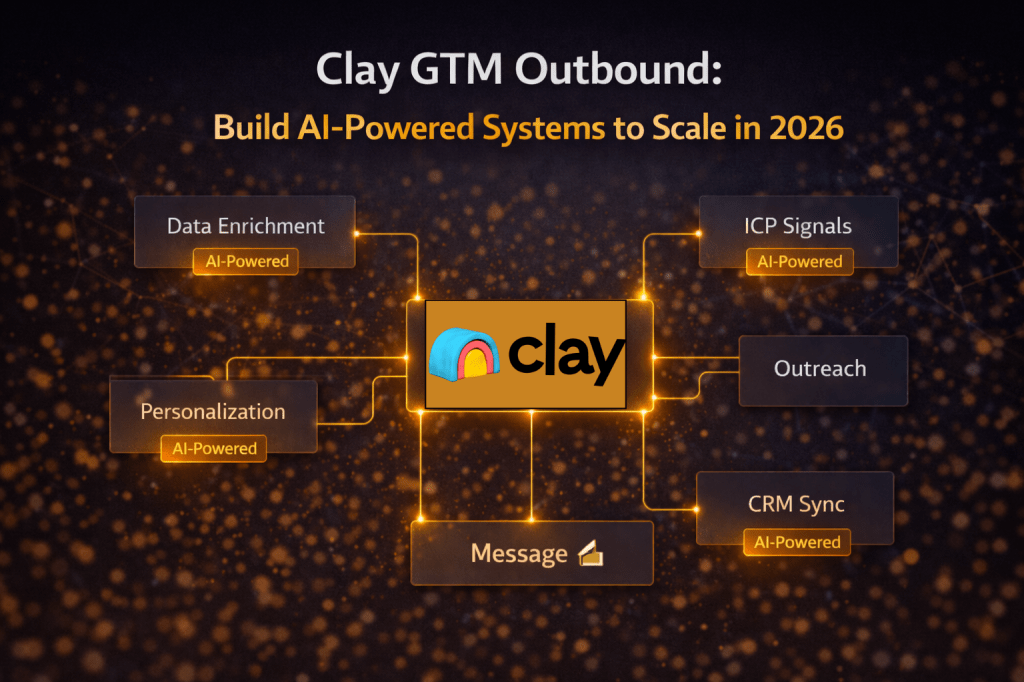
Why Every B2B Founder Needs Clay GTM in 2026
You’ve hit the wall: referrals dried up, LinkedIn/Facebook ads cost 5-10x what they did two years ago, and hiring an SDR team means $15-20k/month before you see a single qualified meeting.
Meanwhile, your competitors are booking 30-50 qualified appointments monthly without a single sales hire.
How?
They’ve built Clay GTM outbound systems—AI-powered data engines that turn LinkedIn profiles and company signals into personalized cold email and LinkedIn sequences that actually get responses.
Clay isn’t just another prospecting tool.
It’s the data brain that sits between your ICP research and your outbound execution, enriching every prospect with real-time signals (hiring trends, tech stack changes, funding events) and generating personalized variables that make your outreach feel human-written.
The results B2B service agencies are seeing:
- 3x better enrichment accuracy than manual research
- 40% time savings on prospecting workflows
- 25-35% multichannel response rates vs. 10-15% from generic spray-and-pray
- Predictable pipeline without ad spend or SDR headcount
Six Figure Consulting has deployed Clay systems for recruitment consultants, SaaS, and professional IT and consulting services firms across the UAE and USA markets, generating high conversion rates from cold outbound.
Why Clay Outbound Beats Every 2026 Alternative?
Let’s compare the four main B2B lead generation strategies:
| Strategy | Monthly Cost | Response Rate | Clay Advantage |
|---|---|---|---|
| Paid Ads | $5,000-15,000 | 1-3% CTR | Zero ad spend; signal-based targeting gets 8-12x better conversion |
| VA/Freelance | $500-2,000 | 10-15% replies | AI personalization; 25-35% multichannel replies without quality drop |
| Manual SDR Team | $15,000-30,000 | 18-25% replies | 90% automation; founders focus on strategy, not micromanagement |
| Clay GTM System | $300-800 | 25-35% multichannel | Full-stack: data + signals + personalization + execution |
The 2026 reality:
- LinkedIn ad CPMs are up 400% since 2022
- Good SDRs cost $60-80k + commission + 3-6 months ramp time
- VAs can’t research context at scale
- Pure inbound takes 12-18 months to generate a consistent pipeline
Clay solves all of this by automating the highest-leverage part of outbound: research and personalization.
Instead of hiring someone to spend 45 minutes researching each prospect, Clay does it in 30 seconds. Instead of guessing what message will resonate, Clay detects signals that indicate timing and pain.
The 7-Step Clay GTM System

Step 1: Define Your ICP with Surgical Precision
Your Clay system is only as good as your targeting.
Company-level filters:
- Industry: Professional consulting services, SaaS, IT, logistics, and recruitment
- Employee count: 50-500 (sweet spot for B2B services)
- Revenue: $5M-50M (proven ability to pay)
- Location: UAE, USA (or your target geography)
- Tech stack: Salesforce, HubSpot, NetSuite
- Growth signals: Recent funding, hiring, expansion
Contact-level filters:
- Title: VP Sales, Head of Revenue Operations, Director of Growth
- Seniority: Director+ (decision-makers)
- Tenure: 6+ months (they understand the pain)
SFC Example: One logistics consulting client targeted 3PL companies, 200-1,000 employees, using legacy TMS systems, recently posted supply chain analyst jobs, based in the UAE.
This precision meant every prospect was already experiencing the pain they solve.
Result: 32% meeting conversion rate.
Step 2: Source Accounts
Best sources:
- LinkedIn Sales Navigator: Filter by company size, industry, geography, and technology
- Apollo.io: B2B database with 275M contacts
- Your existing CRM: Closed-lost deals, dormant leads
Pro tip: Start with 300-500 accounts for your first campaign. Test, learn, optimize, then scale.
Clay table structure:
- Company Name | Company Website | LinkedIn URL | (Enrichment columns)
Step 3: Enrich Accounts First
Use Clay’s waterfall enrichment to fill in missing data:
Company data to enrich:
- Employee count (Clearbit → PeopleDataLabs → Apollo)
- Revenue estimate (Crunchbase → ZoomInfo)
- Tech stack (BuiltWith → Datanyze)
- Job postings (Adzuna → LinkedIn Jobs scraper)
- Recent news/press releases (Bing News API)
Why waterfall? No single data provider has 100% coverage. Clay checks multiple sources sequentially, giving you 90%+ coverage.
Filter aggressively after enrichment:
- Employee count: 100-500
- Industry: Professional Services OR SaaS
- Tech stack contains: Salesforce OR HubSpot
- Job postings in last 90 days: >0
This cuts your list from 5,000 → 200 high-fit accounts. Better to reach 200 perfect companies than 5,000 mediocre ones.
Step 4: Find and Verify Decision-Maker Contacts
Use Clay’s “Find Contacts at Company” enrichments:
- Apollo: Best for North American B2B contacts
- People Data Labs: Strong European + APAC coverage
Title filters:
- VP Sales, VP Revenue, Chief Revenue Officer
- Head of Growth, Head of Business Development
- Director of Sales Operations, Revenue Operations Manager
Verification workflow:
- Find email using waterfall (Apollo → Hunter → RocketReach)
- Verify email deliverability using Zerobounce
- Check the LinkedIn profile exists and is active
- Exclude free email domains (Gmail, Yahoo)
- Exclude junior titles (Coordinator, Specialist)
Step 5: Generate AI Personalization Variables
This is where Clay becomes magical.
Clay AI formulas to use:
Formula 1: Identify pain from tech stack + hiring signals
Prompt: "Based on using {{tech_stack}} and recently hiring for {{job_title}}, what operational challenge is {{company}} likely facing?"Output: "Scaling Salesforce across new AE hires typically causes forecast accuracy and pipeline visibility issues"Formula 2: Create a personalized icebreaker
Prompt: "Write a one-sentence icebreaker for {{contact_name}} at {{company}} based on this context: {{enriched_signals}}"Output: "Sarah, scaling from 10→25 AEs on Salesforce usually creates forecasting headaches—seeing this at Acme?"Real example from SFC client:
Company: Mid-market freight forwarder, Dubai Signals detected:
- Posted 3 logistics coordinator jobs (growth)
- Uses CargoWise TMS (legacy system)
- Recent LinkedIn post about “scaling challenges.”
AI-generated insight: “Growing logistics teams on legacy TMS systems typically hit shipment visibility and client communication bottlenecks—experiencing this?”
Result: 45% email open rate, 28% reply rate (vs. industry average of 12%).
Step 6: Push to Multichannel Cadence (Email + LinkedIn)
The SFC Multichannel Framework:
7-Day Cadence:
| Day | Channel | Action | Message Type |
|---|---|---|---|
| 1 | Initial outreach | Problem + signal-based icebreaker | |
| 3 | Profile view | (Silent, no message) | |
| 4 | Connection request | Short, no pitch | |
| 7 | Follow-up #1 | Case study or insight | |
| 10 | Direct message | Different angle, question-based | |
| 14 | Follow-up #2 | Breakup message or final value |
Email Sequence Example:
Email 1 (Day 1):
Subject: {{tech_stack}} pains amid {{hiring_signal}} at {{company}}?Hi {{first_name}},Noticed {{company}} recently {{signal}} on {{tech_platform}}—most teams hit {{specific_pain}} when scaling from {{size_A}} to {{size_B}}.Seeing this on your end?[Your Name]P.S. Helped {{similar_company}} solve {{pain}} in {{timeframe}}.Email 2 (Day 14 – Breakup):
Subject: Last one, promise{{first_name}},Clearly not the right time—totally get it.If {{pain_point}} bubbles up later, here's the case study: [link]Best of luck scaling {{company}}.LinkedIn Message (Day 10):
"{{first_name}}, noticed you're {{job_title}} at {{company}}—most teams using {{tech}} struggle with {{pain}} when they hit {{size}}. Curious if you're seeing this?"Why multichannel beats email-only:
- 25-35% response rate vs. 10-15% email-only
- Different people check different channels
- LinkedIn adds social proof
- Multi-touch increases brand recall
Step 7: Automate, Track, and Optimize Weekly
Metrics to track (ClickUp dashboard):
Email metrics:
- Deliverability rate: >95%
- Open rate: 30-50%
- Reply rate: 20-30%
- Positive reply rate: 8-15%
- Meeting book rate: 2-5%
LinkedIn metrics:
- Connection acceptance rate: 25-40%
- Message reply rate: 15-25%
- Positive reply rate: 5-12%
Weekly optimization protocol:
Week 1-2: Focus on deliverability and open rates (test subject lines)
Week 3-4: Focus on reply rates (test signal-based angles)
Week 5-8: Focus on meeting conversion (improve qualification)
Week 9-12: Scale what works (double down on winning segments)
Common Clay GTM Mistakes to Avoid
Mistake 1: Enriching everything without filtering
❌ Wrong: Import 10,000 companies, enrich all, get 40% junk data
✅ Right: Filter accounts first, then enrich the qualified subset
Mistake 2: Over-personalizing to the point of creepiness
❌ Wrong: “I saw you went to the University of Texas in 2007…”
✅ Right: “Noticed [Company] recently [relevant business signal]…”
Mistake 3: Sending email-only when your ICP lives on LinkedIn
❌ Wrong: Tech founders and agency owners are on LinkedIn 24/7. Email-only misses them.
✅ Right: Multichannel. LinkedIn DM reply rates for founder-to-founder can hit 40%+
Mistake 4: Launching campaigns without testing deliverability
❌ Wrong: Send 1,000 emails on Day 1, hit spam, domain burned
✅ Right: Start with 50 emails/day, warm up the domain properly (14+ days), then scale
The Clay + Instantly + Heyreach Tech Stack
Layer 1: Data & Enrichment
Layer 2: Execution
- Instantly.ai ($97/month): Cold email sending
- Heyreach ($79-100/month): LinkedIn automation
Layer 3: Tracking
- GHL ($12-19/seat): Leads tracking + workflow automation
Total monthly cost: $600-1,200 (vs. $15,000+ for SDR team)
Set up timeline:
- Week 1: Domain setup + warmup
- Week 2: Clay table + enrichment
- Week 3: Sequence creation + testing
- Week 4: Launch + optimize
Advanced Clay Plays for Experienced Operators
Play 1: Competitor Customer Poaching
- Build a list of competitors’ customers (G2 reviews, case studies)
- Enrich in Clay with contract renewal timelines
- Time outreach 60-90 days before renewal
- Message: “Most [competitor] customers hit [pain] around [trigger]—seeing this?”
Play 2: Technology Migration Triggers
- Use BuiltWith to track companies changing tech stacks
- Identify migrations (e.g., Mailchimp → HubSpot)
- Time outreach during implementation (30-90 days post-switch)
- Offer migration playbook
Play 3: Hiring Signal Stacking
Stack multiple job postings:
- Posted 3+ sales roles = aggressive growth
- Posted SDR + Sales Ops roles = building infrastructure
- Posted RevOps + Data Analyst = sophistication play
Adjust messaging based on signal intensity.
How SFC Thinks About Clay GTM
At Six Figure Consulting, we don’t sell Clay as a “tool.”
We build GTM systems where Clay is the brain.
What we build for clients:
- ICP + signal library (not just “who” but “when” and “why now”)
- Enrichment infrastructure (20+ data sources in waterfall logic)
- AI personalization engine (custom prompts for their industry)
- Multichannel cadences (email + LinkedIn sequences that stack)
- Weekly optimization rituals (data-driven tweaks every 7 days)
Why founders hire us vs. DIY:
DIY reality:
- 40-60 hours to learn Clay + Instantly + Waalaxy
- 20+ hours/week maintaining campaigns
- Trial and error = 4-8 weeks before results
SFC approach:
- Week 1: ICP + research
- Week 2: Setup + enrichment
- Week 3: Campaigns live
- Week 4: First meetings booked
Your Next 7 Days
Day 1: Define your ICP using the framework above
Day 2: Source 300 accounts from LinkedIn Sales Nav or Apollo
Day 3: Sign up for Clay, import accounts, start enrichment
Day 4: Set up Instantly.ai, configure domains, begin warmup
Day 5: Write 3 email variations + 2 LinkedIn message angles
Day 6: Build your first Clay→Instantly workflow
Day 7: Launch to 50 contacts, measure, iterate
One week from now, you’ll have:
- Qualified account list with full enrichment
- Personalized sequences ready to send
- Multichannel infrastructure set up
- First batch of outreach live
90 days from now, you’ll have:
- Consistent 25-35 monthly meetings
- Proven playbook for your ICP
- Pipeline is independent of referrals
- Foundation to scale to 100+ meetings/month
Clay GTM outbound isn’t a “nice to have” in 2026. It’s table stakes for B2B service businesses that want predictable growth.
Newsletter CTA
Want weekly GTM insights like this?
Join 1,200+ B2B founders getting tactical playbooks on AI-powered outbound, signal-based prospecting, and revenue systems.
Subscribe to SFC’s GTM Newsletter → One email/week, unsubscribe anytime.
Ready to Build Your Clay GTM System?
Book a 30-minute strategy audit with SFC.
We’ll:
- Review your current ICP and targeting
- Identify high-signal enrichment opportunities
- Map your ideal multichannel cadence
- Show you what’s possible in 30-90 days
Book Your Free Clay GTM Audit →
Or email ankit@sixfigureconsulting.co with subject “CLAY” to get our prompt pack + enrichment checklist.

Leave a comment